For more than a century, educational research has advanced our understanding of how students learn and how learning can be measured. Developmental psychology, cognitive science, neuroscience, educational psychology, assessment, and psychometrics have each contributed important insights into learning, memory, reasoning, instruction, and achievement. Yet one important question remains insufficiently explored:
What constitutes trustworthy educational evidence that meaningful understanding is developing?
Traditional educational measurement has relied heavily on standardized assessments, grades, and periodic evaluations. These approaches have made important contributions to the reliability, comparability, and scalability of educational measurement. They remain valuable sources of evidence. But they usually capture performance at discrete points in time.
Teachers experience learning differently. They observe explanations becoming clearer, misconceptions changing, ideas connecting, knowledge transferring to new situations, students becoming more independent, and understanding strengthening through instruction and feedback. These observations also constitute educational evidence, but historically they have been difficult to capture, organize, analyze, and use systematically across time.
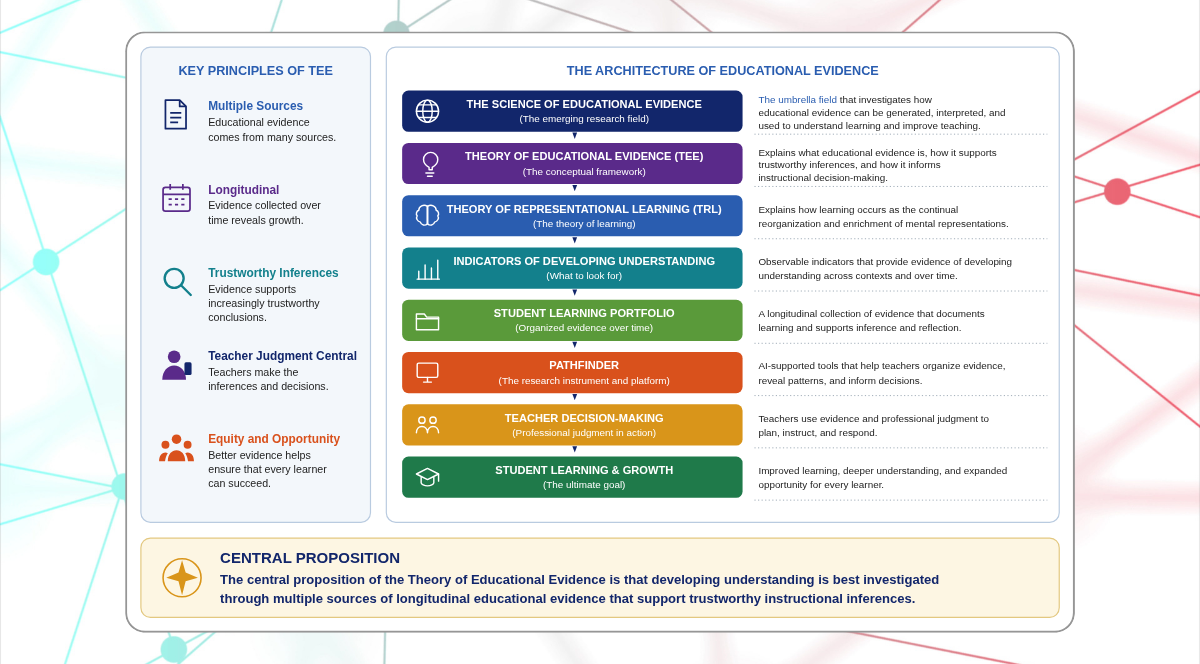
The Theory of Educational Evidence (TEE) proposes that developing understanding can be investigated through multiple sources of longitudinal educational evidence. Student work, teacher observations, classroom dialogue, performance tasks, reflections, demonstrations of transfer, formative and standardized assessments, and other evidence can be examined collectively to support increasingly trustworthy inferences about how understanding develops.
TEE does not replace traditional assessment. It expands the educational evidence available for understanding learning. Its central proposition is:
Developing understanding is best investigated through multiple sources of longitudinal educational evidence that support trustworthy instructional inferences.
The theory is informed by the Theory of Representational Learning (TRL), which proposes that meaningful learning involves the reorganization and enrichment of mental representations into increasingly coherent, connected, durable, and transferable patterns of understanding. If learning involves representational change, then educational research should seek observable evidence that such change is occurring. TEE provides a framework for identifying, organizing, interpreting, and testing that evidence.
The SchoolWorks Lab advances the science of learning by investigating how teachers use multiple sources of longitudinal educational evidence to make trustworthy inferences about developing understanding, improve instructional decision-making, and expand educational opportunity for every learner.
Pathfinder is the first operational implementation of this research agenda. It is designed to help educators collect and organize longitudinal educational evidence, recognize patterns across time, and use artificial intelligence to reduce the burden of managing that evidence—while preserving teacher judgment as the central element of instructional decision-making.
The research agenda therefore moves through a connected sequence:
Science of Educational Evidence → Theory of Educational Evidence → Representational Learning → Educational Evidence → Teacher Inference → Instructional Decision → New Evidence → Developing Understanding
The ultimate research question is practical:
Can better use of educational evidence help teachers understand learning while it is developing—and use that understanding to improve outcomes for every learner?