Turn student data into actionable teaching insights.
Pathfinder helps teachers see student learning clearly, understand what it means, and know what to do next — through research-grounded diagnostics and co-designed school pilots.
Pathfinder gives teachers a fast read on where their class stands before a lesson starts — and again after it ends. The gap between those two points is the signal. That growth signal is what drives instruction.
Schools don't need more data. They need clarity about what to do next.
Despite abundant tools, teachers navigate fragmented systems that add workload rather than reduce it. Assessment becomes a burden instead of a guide.
Teacher Burnout from
Assessment Burden
Results land after the planning window closes. By the time the data is processed, the teachable moment has passed.
Feedback That Arrives Too Late
Without a fast, reliable read on where students stand, teachers can’t group effectively, differentiate instruction, or target support to the students who need it most.
Instruction WithoutA Growth Signal
How It Works
Pathfinder's three commitments.
See
Collect a fast read on where your class stands. Entry ticket. 3 questions. Under 3 minutes. You see the growth signal before the lesson starts.
Understand
The class snapshot sorts students into three buckets — strong, developing, needs help — and surfaces which specific skills are driving the gaps.
Guide
One paragraph. AI-generated from your class data. What the class needs before the next lesson. One question to open class tomorrow. Done.
Planning moves from ‘What did they get wrong?’ to ‘Here’s what we’ll do tomorrow.’
The Diagnostic Loop
Entry ticket. Class snapshot. Bridge suggestion. Exit ticket. Delta.
That’s the loop. A student completes a 3-question entry ticket at the start of class. The teacher gets a snapshot of where the class stands. Pathfindergenerates a one-paragraph bridge suggestion. After the lesson, students complete an exit ticket. The delta — exit score minus entry score — is the growth signal. Even +2 is success.
The simplicity is the point. The depth is what makes it work.
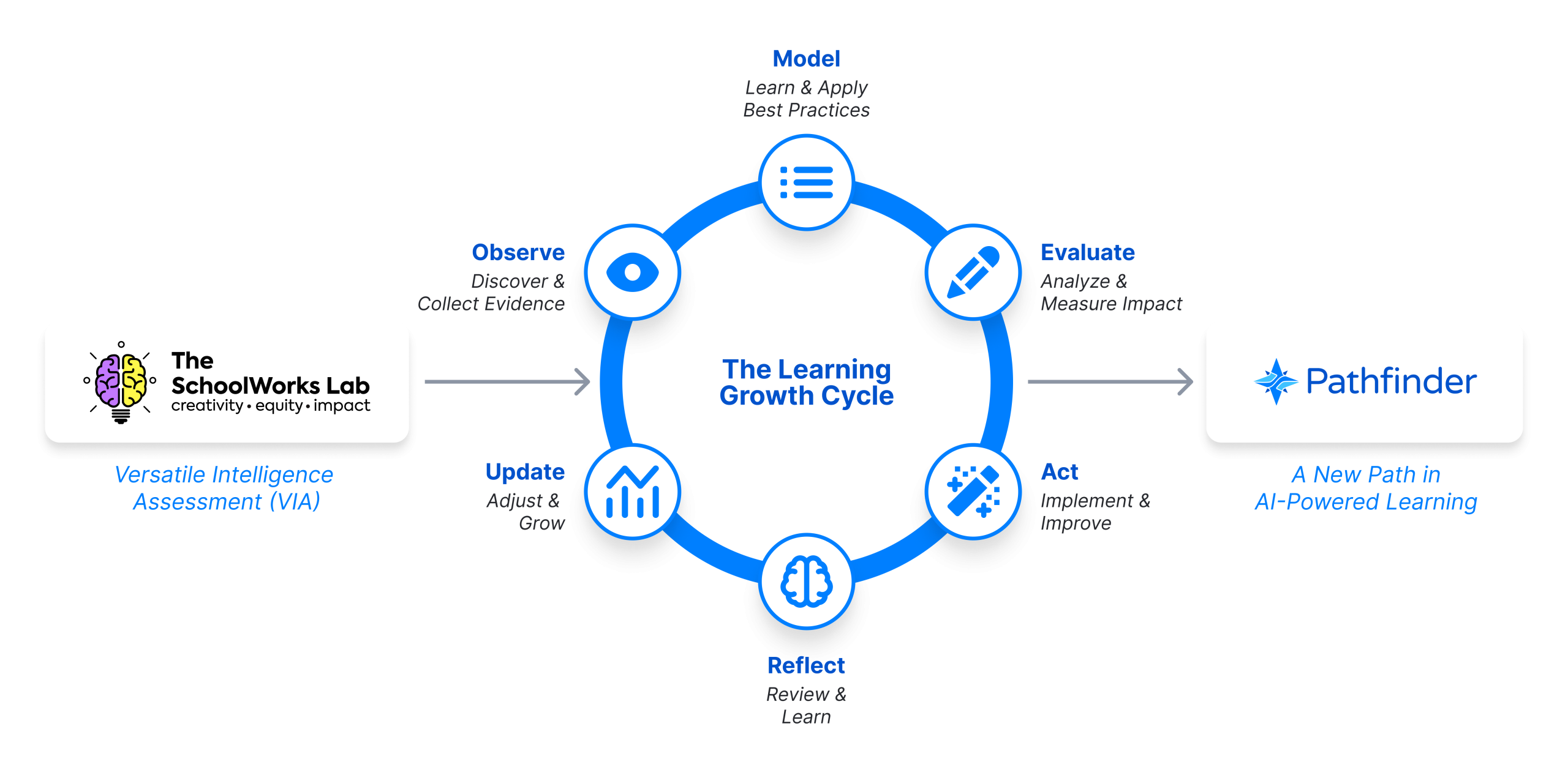
Pathfinder looks simple because it was designed to be simple. Three questions before class. A snapshot. A suggestion. An exit ticket. A delta. But that workflow didn’t come from convenience. It came from two years of sustained research and architectural design grounded in the Versatile Intelligence and Assessment (VIA) framework — a theory of learning that treats intelligence as dynamic, developmental, and multidimensional.
VIA asks a different question than most assessment systems. Not “what did this student get wrong?” but “how does this student learn, and what should happen next?” Every design decision in Pathfinder (what gets measured, how it gets surfaced, what the teacher sees) is an answer to that question.
"The five-screen workflow is not a reduction of that thinking. It's the surface expression of it."
— Dr. Robert A. Southworth, Jr.
Pathways to Learning
Online Diagnostic Center
Pathfinder’s Online Diagnostic Center gives students, teachers, administrators, and parents direct access to powerful literacy and intelligence diagnostics. Every interaction helps build a curated portrait of student growth — informing instruction, guiding support, and connecting educators to the broader Pathfinder ecosystem.
The Learning Loop
Built on a theory of how learning actually works
Pathfinderis grounded in the Versatile Intelligence and Assessment (VIA) framework — a model that treats learning as dynamic, developmental, and multi-dimensional. That foundation shapes every product decision: what we measure, how we surface it, and what we ask teachers to do with it. Learn more at SchoolWorks Lab.
AI as Augmentation, Not Automation
Pathfinder uses AI for two specific jobs — and nothing else.
When a teacher uploads or describes a curriculum topic, AI generates a set of diagnostic questions aligned to it. The teacher reviews and approves every question before students see it.
After the entry ticket closes, AI reads the class snapshot and writes a one-paragraph bridge suggestion — what the class needs before the next lesson, one question to open class tomorrow. The teacher can edit or ignore it entirely.
Everything else — grouping decisions, instructional moves, next steps — stays with the teacher. AI assists. It doesn’t drive.
Our Team
Founding Leaders
Our leadership team brings together educators, designers, and researchers with experience in public schools, education reform, and educational technology. We co-design with schools to keep teachers in control and students at the center, delivering standards-aligned solutions that are transparent, customizable, and built with privacy and equity in mind.
Robert A. Southworth, Jr., Ed.D.
Founder and Chief Executive Officer
As founder and CEO, Dr. Robert A. Southworth, Jr., leads Pathfinder‘s mission to revolutionize educational assessment. His background in educational research and innovation drives the development of intelligence solutions that help teachers identify learning gaps and personalize instruction.
As Director of Tech Implementation & Branding, Jenny Lynn Weitz ensures Pathfinder‘s technology delivers seamless user experiences for educators. She leads platform design and deployment while collaborating directly with schools to translate technical needs into intuitive interfaces that support effective teaching and learning.
As CTO /Tech Lead, Scott Cartwright oversees the design and development of Pathfinder‘s educational applications. He leads UX/UI design and ensures our digital tools meet both technical standards and educational goals, working directly with educators to continuously refine and innovate technology solutions.
As Educational Research Associate, Bharti Sharma evaluates and refines Pathfinder‘s educational products through rigorous research and analysis. She provides evidence-based feedback to support product development and ensures our solutions remain grounded in educational research while meeting real-world teaching and assessment needs.